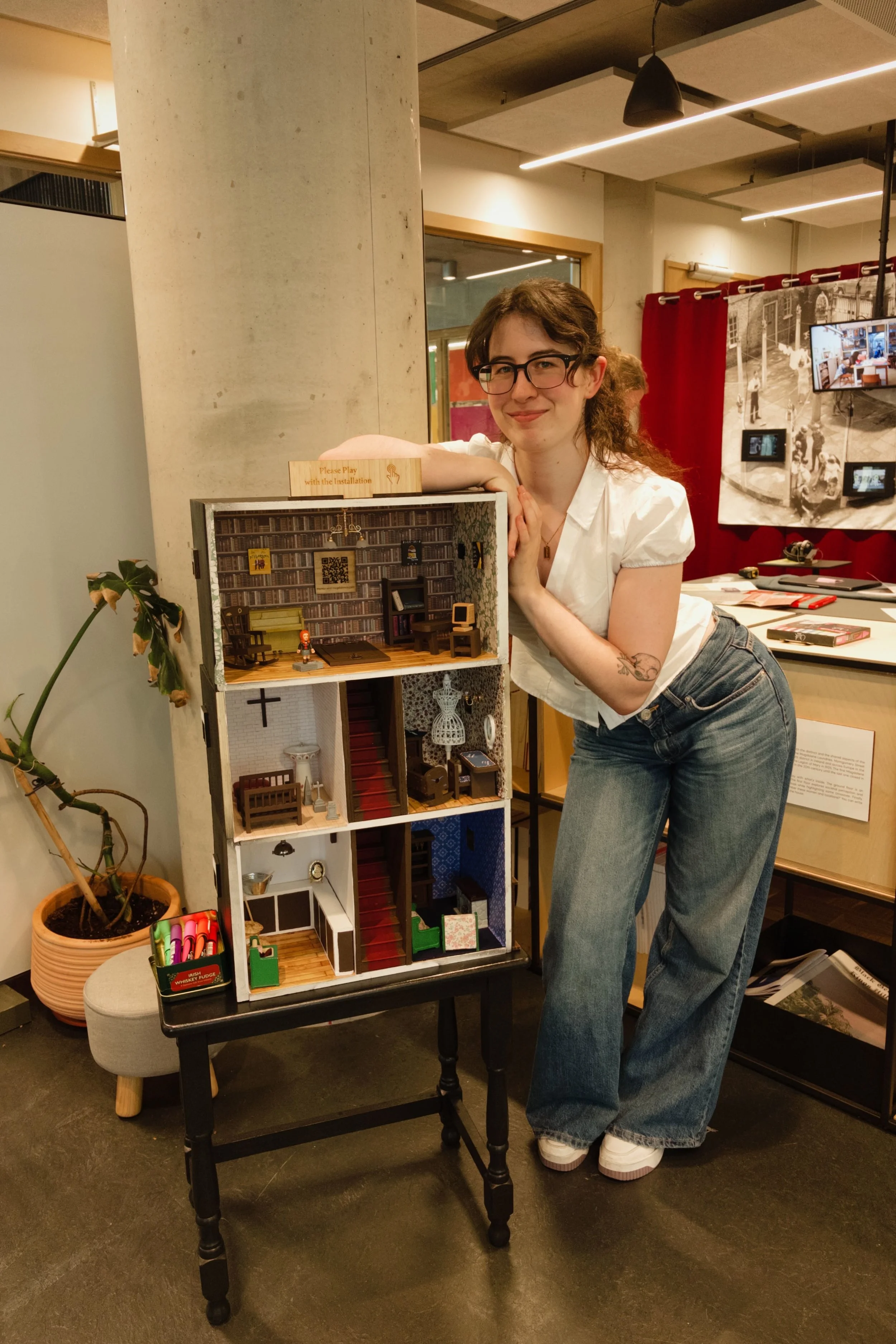
The house is a space for the audience to connect with the women. I wanted to tackle these difficult histories through this medium to remind the audience that these women were children before. They grew up just like the audience members have.
Davy and Dixon highlight this idea of the miniature embodying multiple aspects: ‘a miniature object that resembles a particular thing can simultaneously be a representation of something else, something less tangible’. Having the dollhouse freeze this moment in Irish history, allowing the audience to learn, bring it to life, and make connections through play, was a driving factor in its construction.
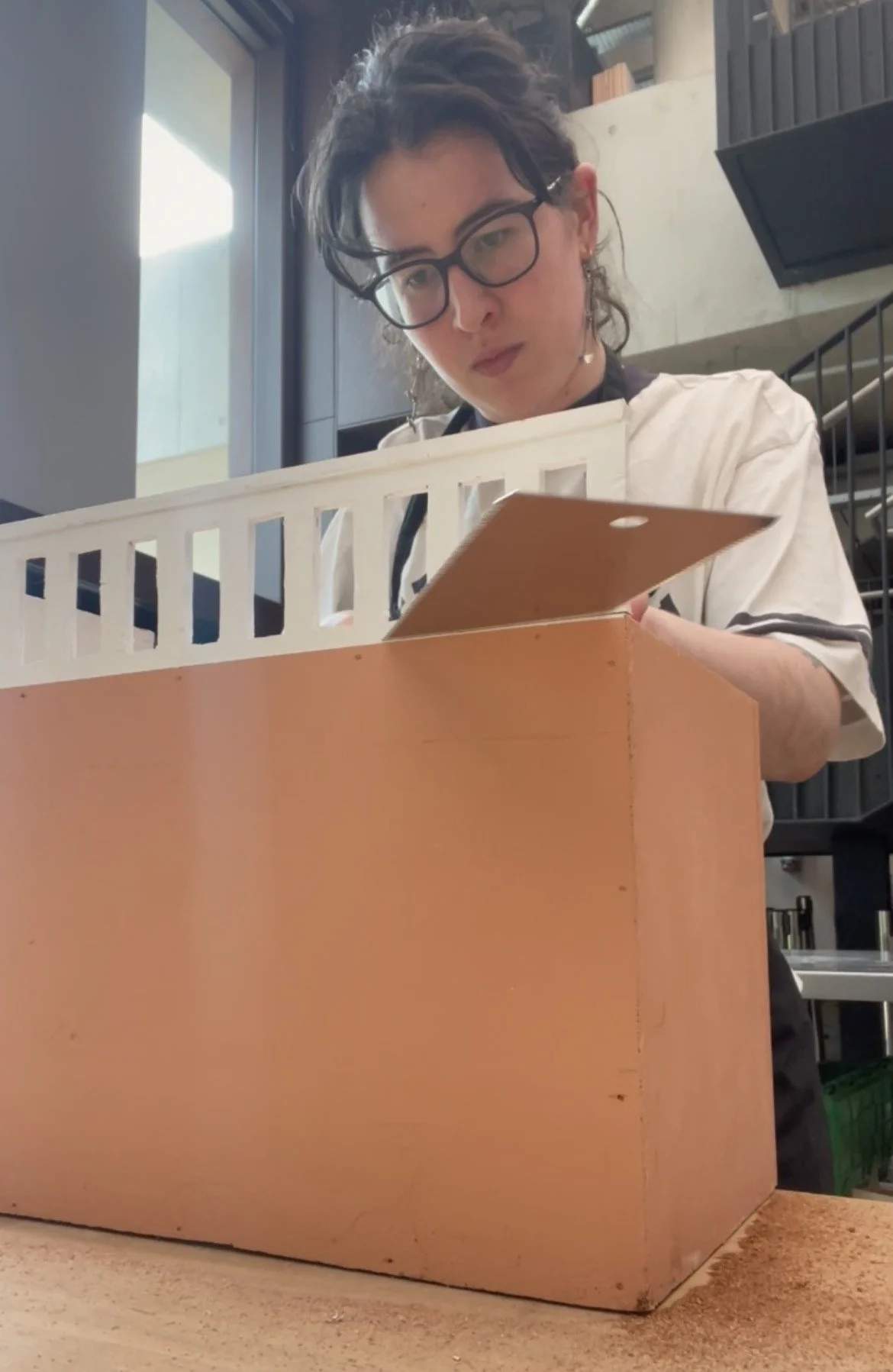
When building the dollhouse, the staff at the Institute of Making helped me create the middle floor using traditional woodwork tools. More detailed parts of the house - the door, QR code and window frames - were produced with the Universal Laser Cutter at the IoM. The furniture and rooms were refurbished from friends’ dollhouses. The only pieces in the house that are 3D printed are the three graves. However, all the pieces were hand-painted. There is potential to add wooden trimmings to the outside using traditional methods for future versions of this project.
From replicating the Georgian House style when creating the dollhouse to matching historical wallpaper in the rooms, the house and the objects inside are made to reflect the spaces the women existed in both institutions - Monto and the Magdalene Laundries. This is a way for the audience to engage with the past and create connections in the moment.
A doll was not included in this version of the house. The next step is to design and create a hand-sewn doll. With the doll, the audience can remove the hair to observe the hidden ‘bobbed’ haircut underneath. Dresses will be provided in the cupboard and on the dress mannequin in the social room. The clothing will replicate the uniforms in the Magdalene Laundries and the dresses present in Monto.
About the House
About Me
Ceara Walsh
I am an MA Public History Student at the University College London (UCL). From my Undergraduate studies in Ireland to my Master’s dissertation project, my research has been centred around history, Ireland, and societal oppression. I had the opportunity to apply to the 1st and 3rd Joint Program in Korean Studies, where I presented on Korean feminism and a comparative study of the Mother and Baby Homes in Ireland and the Brother Home in Korea. The latter topic inspired me to delve more into hidden histories that are often forgotten or erased from public memory.